AMD Ryzen PRO 9000 Series Launched: World’s First 3D V-Cache Workstation CPUs
Quick Highlights
AMD is expanding its workstation and enterprise desktop CPU lineup with the Ryzen PRO 9000 Series, and this launch carries a major first for professional users: AMD 3D V-Cache is officially coming to commercial workstation-class processors.
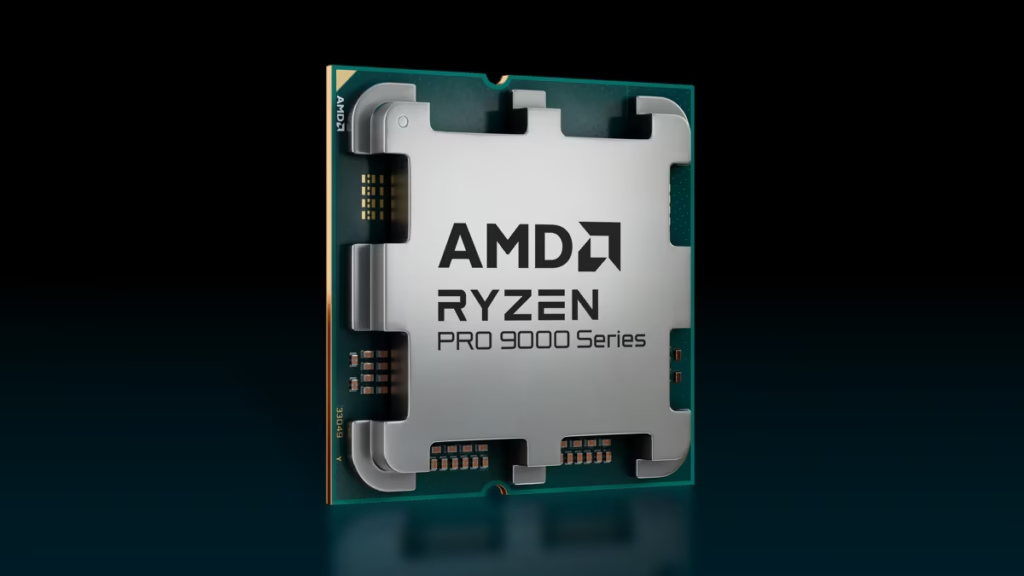
Until now, AMD’s stacked cache technology has been primarily marketed toward gamers and enthusiast desktop buyers. But with the Ryzen PRO 9000 lineup, AMD is pushing 3D V-Cache into the business and workstation space — targeting workloads where cache-heavy performance can translate directly into real productivity gains.
The processors are expected to arrive in the second half of 2026, and AMD has confirmed Lenovo as one of the first OEM partners, with the chips set to appear in upcoming ThinkStation P4 workstation systems.
For official AMD processor announcements and spec confirmation, users can refer to AMD’s official newsroom.
What 3D V-Cache Means for Workstations
AMD’s 3D V-Cache is a stacked cache technology where additional L3 cache is physically layered on top of the CPU die. This significantly boosts the amount of data the processor can access instantly without needing to reach slower system RAM.
In consumer gaming CPUs, this technology has already proven to be a performance multiplier in cache-sensitive workloads. Bringing it to workstation-class Ryzen PRO processors suggests AMD is now targeting a more serious segment: professionals whose work depends on high-speed iteration, large datasets, and complex compute pipelines.
For workstation users, this is not about “gaming FPS.” It’s about reducing bottlenecks in workflows where performance isn’t always limited by core count, but by how quickly the CPU can repeatedly access the same dataset.
This can directly benefit tasks like:
High-resolution video timelines and real-time editing
Physics simulations and engineering analysis
Complex CAD models and design pipelines
Rendering, compositing, and 3D workloads
It also aligns with a broader trend in computing where “real performance” increasingly depends on smarter architecture improvements, not just higher clock speeds.
As enterprises adopt more AI and cloud-connected workflows, trust and software authenticity are becoming critical topics — similar to what Google is targeting with Android 17 Introduces Powerful OS Verification Tool to Detect Fake Android Versions and Protect Users.
Ryzen PRO 9000 Series: X3D Models Confirmed
AMD’s PRO workstation lineup includes two X3D processors with 3D V-Cache technology.
Ryzen PRO 9000 X3D Models (Specs)
AMD Ryzen 9 PRO 9965X3D
16 cores / 32 threads
Up to 5.5GHz boost / 4.3GHz base
144MB total cache
170W TDP
AMD Ryzen 7 PRO 9755X3D
8 cores / 16 threads
Up to 5.2GHz boost / 4.7GHz base
104MB total cache
120W TDP
The headline here is the cache. 144MB total cache on a workstation CPU is a serious number, and for certain professional workloads, it can deliver performance improvements that simply aren’t possible through clock speed tuning alone.
Ryzen PRO 9000 Series: Non-X3D Models (Standard PRO CPUs)
AMD is also launching several standard Ryzen PRO 9000 processors without stacked cache.
Ryzen PRO 9000 Standard Models (Specs)
AMD Ryzen 9 PRO 9965
16 cores / 32 threads
Up to 5.5GHz boost / 4.3GHz base
80MB total cache
170W TDP
AMD Ryzen 9 PRO 9955
12 cores / 24 threads
Up to 5.4GHz boost / 3.4GHz base
76MB total cache
120W TDP
AMD Ryzen 9 PRO 9945
12 cores / 24 threads
Up to 5.4GHz boost / 3.4GHz base
76MB total cache
65W TDP
AMD Ryzen 7 PRO 9755
8 cores / 16 threads
Up to 5.4GHz boost / 3.8GHz base
40MB total cache
120W TDP
AMD Ryzen 7 PRO 9745
8 cores / 16 threads
Up to 5.4GHz boost / 3.8GHz base
40MB total cache
65W TDP
AMD Ryzen 5 PRO 9655
6 cores / 12 threads
Up to 5.4GHz boost / 3.9GHz base
38MB total cache
120W TDP
AMD Ryzen 5 PRO 9645
6 cores / 12 threads
Up to 5.4GHz boost / 3.9GHz base
38MB total cache
65W TDP
This lineup is clearly built to serve both performance-focused workstations and power-efficient enterprise desktops, which is critical for IT teams deploying systems at scale.
A Wide Range of Power Profiles for Real Business Use
One of the most practical aspects of this Ryzen PRO 9000 launch is the TDP range. AMD is offering both high-performance 120W and 170W parts, along with lower-power 65W options.
That matters because workstation deployments aren’t always about maximum power. Many companies prioritize:
Lower thermal output
Quieter work environments
Better sustained performance in compact cases
More predictable power consumption for offices
AMD appears to be covering both extremes, allowing OEMs to configure systems based on workflow and chassis design.
Target Workflows: Where AMD Wants to Win
AMD is positioning Ryzen PRO 9000 as a solution for three major workstation segments.
Media and Entertainment
AMD says these CPUs are designed for workflows like:
Real-time 4K and 8K video editing
Faster encoding and exports
Compositing pipelines
Content creation paired with Radeon PRO graphics
Cache-heavy performance can be especially useful for editors and creators working with large timelines and repeated data calls.
Architecture, Engineering, and Construction (AEC)
For AEC professionals, AMD is targeting:
Complex BIM modeling
CAD visualization
Real-time rendering in design tools
This segment is traditionally dominated by Intel Xeon-powered workstations, so AMD clearly wants to take that market share with a more modern performance approach.
Manufacturing and Mechanical Design
In industrial design workflows, AMD is focusing on:
3D CAD
Simulation performance
Faster design iteration cycles
This is one of the best places for 3D V-Cache to matter because many simulation tasks can become memory-latency limited rather than purely core-limited.
Why 3D V-Cache Could Be AMD’s Competitive Advantage vs Xeon
The workstation market has long relied on Intel Xeon as the default choice for reliability, enterprise certifications, and OEM availability.
But AMD is now attempting to disrupt that with a simple pitch: faster productivity without relying only on core count.
Instead of brute-forcing performance with more cores or higher clock speeds, AMD is betting on cache improvements — which can offer major gains in workloads where data reuse is heavy.
If real-world benchmarks confirm large performance boosts, Ryzen PRO X3D chips could become the “smart workstation buy” for users who don’t want to jump into extremely expensive HEDT or server-class CPU platforms.
This performance-focused workstation push also ties into the larger industry shift where AI is becoming deeply integrated into productivity hardware, much like the upcoming ecosystem direction explained in Apple Intelligence Could Soon Let Users Choose ChatGPT, Gemini, or Claude — and It May Redefine the iPhone AI Era.
Lenovo ThinkStation P4 Confirmed as an Early Platform
Lenovo is confirmed as one of the first OEM partners, with Ryzen PRO 9000 Series chips expected to appear in its ThinkStation P4 lineup.
That’s important because Lenovo’s workstation ecosystem is widely adopted in professional environments and often includes industry certifications for creative and engineering software.
If Ryzen PRO 9000 systems enter that ecosystem smoothly, it gives AMD instant credibility in the enterprise workstation space.
Release Window: When Ryzen PRO 9000 Workstation CPUs Will Launch
AMD says the Ryzen PRO 9000 Series processors are expected to be available in the second half of 2026.
This means OEM systems will likely start appearing closer to late 2026, with broader commercial availability depending on Lenovo and other partners.
TechularZtrix Take: AMD’s Workstation Strategy Is Getting Serious
Ryzen PRO has always been a solid “business desktop” lineup, but adding 3D V-Cache changes the conversation.
This is AMD pushing workstation CPUs into a performance category that isn’t based purely on core count — but on real-world workload efficiency. For creators, engineers, and professionals dealing with data-heavy tasks, cache upgrades can matter more than small clock speed jumps.
If the Ryzen 9 PRO 9965X3D delivers strong benchmark gains in simulation and rendering, it could become one of the most important workstation CPUs AMD has launched in years.
This shift also reflects how modern computing is evolving beyond raw power, as AI-driven workloads and efficiency-focused upgrades become just as important as battery longevity trends in EV tech like EV Battery Degradation Explained: 7 Critical Factors That Matter
AMD 3D V-Cache is a technology that stacks extra cache memory on top of the CPU die, allowing faster access to frequently used data.
More cache reduces the need to access slower system RAM, improving performance in workloads like simulation, rendering, and data-heavy tasks.
AMD has confirmed Ryzen 9 PRO 9965X3D and Ryzen 7 PRO 9755X3D as X3D models with stacked cache.
AMD expects availability in the second half of 2026.
Lenovo is confirmed as one of the first OEM partners, with the ThinkStation P4 expected to showcase the processors.