ChatGPT’s New Finance Feature Could Be Powerful — But It Requires Bank Access
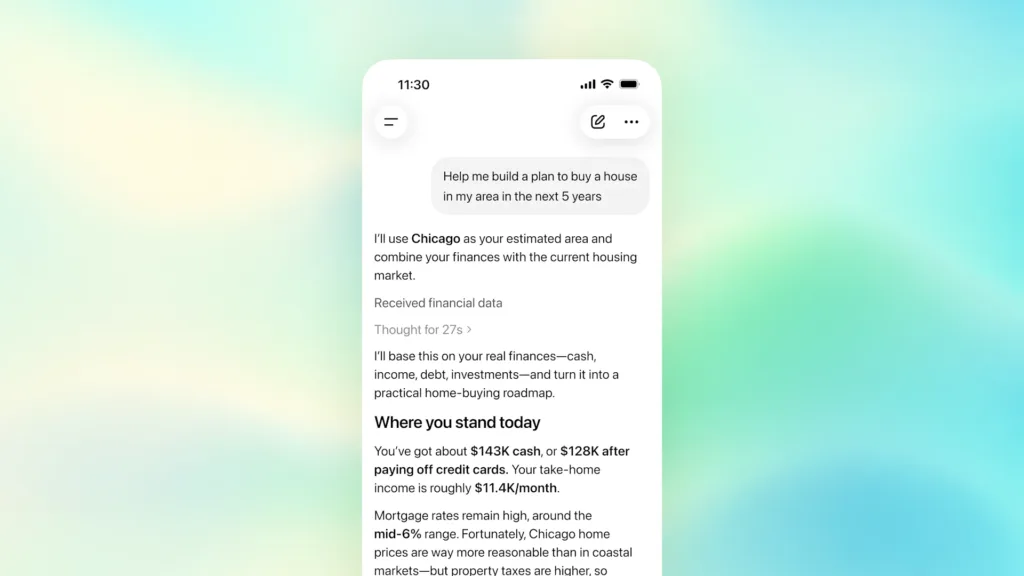
OpenAI is taking ChatGPT into a new territory that most AI companies have avoided so far: direct personal finance assistance. Starting today, the company has begun rolling out a preview feature that allows ChatGPT Pro users in the US to connect their bank accounts and receive personalized money advice based on real spending patterns.
The update could turn ChatGPT from a general chatbot into something closer to a financial co-pilot — but it also raises the most obvious question: how comfortable are users with sharing bank data with AI?
According to OpenAI, this feature is designed for people who already use ChatGPT to ask about budgeting, savings planning, debt management, and subscription tracking. Now, instead of giving generic recommendations, ChatGPT can build answers based on the user’s own account activity.
The rollout is happening through a partnership with Plaid, a widely used financial connectivity platform that supports thousands of banks and services.
OpenAI has confirmed the feature in its official update on OpenAI’s website.
How the New “Finances” Feature Works in ChatGPT
Once enabled, users will see a dedicated Finances section inside ChatGPT’s sidebar. OpenAI says users can also activate it by typing something like “connect my accounts” and ChatGPT will guide them through the setup process.
The connection happens through Plaid, meaning users are redirected to a secure interface to select their bank and authenticate access.
After linking accounts, ChatGPT begins generating a dashboard-like view of the user’s financial situation, which may take a few minutes to populate. From there, users can ask questions in normal language — not just “what’s my balance,” but queries like:
- “How much did I overspend this month?”
- “Which subscriptions should I cancel?”
- “Can I afford a new phone upgrade?”
- “What’s my best strategy to clear credit card debt faster?”
This is where the feature becomes far more useful than typical finance apps, because it focuses on explanation and guidance, not just charts.
This type of AI assistant approach also fits the larger direction of consumer AI, similar to how Meta is expanding wearable AI experiences like its smart glasses platform. (You can see how this trend is evolving in our recent post on Meta Ray-Ban Display updates.)
What ChatGPT Can See (And What It Claims It Cannot)
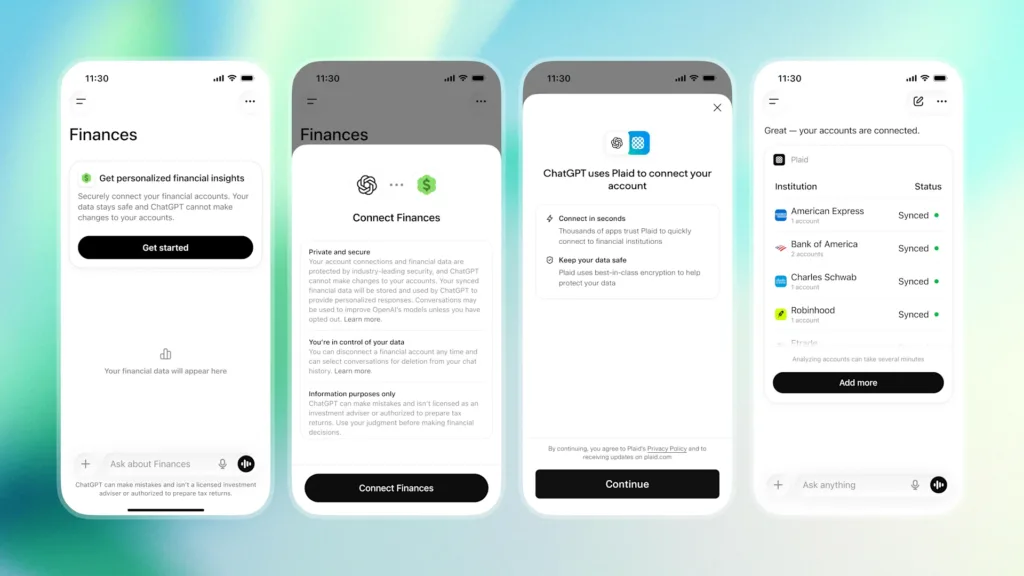
OpenAI says the integration is designed with strict visibility limits. ChatGPT can access only certain data categories such as:
- Balances
- Transactions
- Investments
- Liabilities
However, OpenAI claims ChatGPT cannot see full bank account numbers and cannot make any changes or transfers using this connection.
More importantly, OpenAI says users can disconnect their accounts anytime, and users can also review or delete any financial “memories” ChatGPT stores about their situation.
This focus on privacy comes at a time when more platforms are pushing “private AI conversations,” similar to WhatsApp’s approach with AI privacy tools, which we covered earlier in WhatsApp Incognito Chat with Meta AI.
Why This Update Is a Bigger Shift Than It Looks
This isn’t just a new feature — it’s OpenAI stepping into a space that banks and fintech apps dominate. Personal finance is one of the most valuable user data categories, and the companies that control financial decision-making often control user loyalty.
If ChatGPT can reliably analyze income, spending habits, subscriptions, and investments, it could become a serious alternative to budgeting apps.
This also signals that OpenAI is building a system where ChatGPT becomes more “connected” to real services, not just the internet. We’re already seeing similar expansion moves across AI platforms, including partnerships like Anthropic Claude’s productivity integration push, which we recently covered in our post on Claude and Microsoft 365 integration.
The Risk Factor: Trust Will Decide Everything
Even if the feature is useful, OpenAI is asking for something major: permission to view sensitive financial history. That is where adoption could slow down.
For many users, financial transactions are more private than photos, messages, or browsing history. The idea of an AI model reading spending patterns, debt, and investments will naturally trigger skepticism.
OpenAI seems aware of that concern, which is why the company is emphasizing control features such as account disconnect options and memory deletion.
Still, the success of this rollout will depend on one thing: whether users believe OpenAI can keep this data secure.
Availability: Who Gets It First?
For now, OpenAI says the finance connection feature is only available as a preview to:
ChatGPT Pro users in the United States
But the company has hinted that if the rollout performs well, it may expand later to Plus subscribers and other regions.
What This Means for the Future of AI Assistants
The biggest takeaway is simple: AI assistants are no longer staying inside the “chat box.” They’re becoming platforms that connect to real-world accounts and services.
If this feature succeeds, it could lead to future integrations with things like bill payments, subscription renewals, expense automation, and even financial planning.
It’s an ambitious step — and potentially a dangerous one if not handled carefully — but it’s also the clearest signal yet that OpenAI wants ChatGPT to become a real daily utility.
No. OpenAI claims the system cannot view full account numbers.
No. The integration is meant for reading balances and transaction history only.
It is rolling out to ChatGPT Pro users in the US.
Yes. OpenAI says users can disconnect at any time from the Finances section.
OpenAI has suggested that it may expand to more users in the future, but no timeline is confirmed.