Intel Reportedly Begins Producing Apple Chips for Older iPhones, iPads, and Macs — A Quiet but Major Shift
Quick Highlights
Intel may have just landed one of the most valuable manufacturing wins in the semiconductor industry. A new report suggests the chipmaker has started early-stage production of Apple processors, potentially marking the beginning of a long-term supply chain partnership between two companies that were once seen as rivals in the PC era.
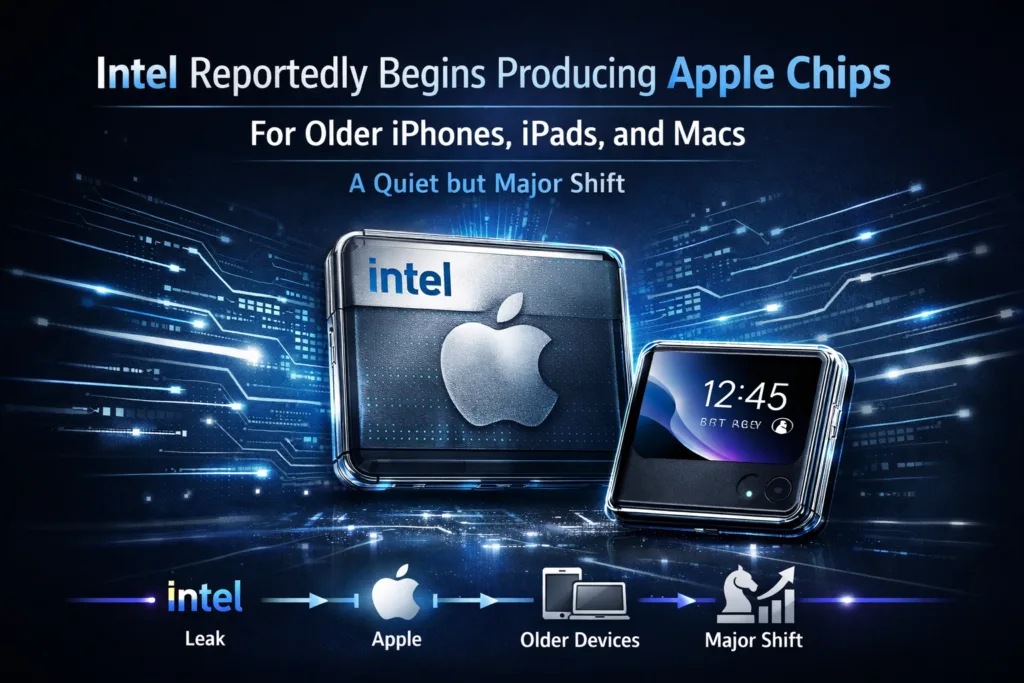
According to analyst Ming-Chi Kuo, Intel has begun producing Apple chipsets for select iPhone, iPad, and Mac devices. However, these are reportedly not Apple’s latest flagship processors. Instead, Intel is believed to be manufacturing legacy or low-end Apple chips for older devices that Apple still sells globally.
If accurate, this move signals something bigger than a single chip order — it points to Apple slowly building a more diversified chip manufacturing pipeline beyond TSMC.
Intel’s Apple Chip Production: What the Leak Actually Claims
The report comes from well-known Apple analyst Ming-Chi Kuo, who says Intel has entered the early production stage of manufacturing Apple processors. The chips are reportedly being produced using Intel’s 18A-P process node, combined with Foveros advanced packaging technology.
Kuo claims the production mix is roughly 80 percent iPhone-related, which aligns with Apple’s overall sales structure, where the iPhone remains the company’s biggest product category.
The more important detail, though, is that Intel is reportedly handling older-generation processors, likely meant for devices that remain in Apple’s lineup but do not require the latest silicon.
This suggests Intel is being positioned as a supplementary supplier rather than a replacement for Apple’s main chip partner.
Why Apple Would Bring Intel Into the Supply Chain Now
Apple’s chip strategy has historically been straightforward: design in-house, manufacture through TSMC, and tightly optimize hardware and software together. So the idea of Intel entering the equation is significant.
But the reason may be less dramatic than it sounds.
Apple still sells older iPhones and iPads in many regions, and maintaining production for those models requires consistent chip availability. By assigning that workload to Intel, Apple reduces its dependency on a single supplier while keeping TSMC focused on higher-end chips.
This kind of diversification has become increasingly important as geopolitical risks, manufacturing constraints, and AI-driven hardware demand reshape the semiconductor landscape.
Apple’s own long-term direction also makes this shift easier to understand. Its silicon roadmap is becoming more critical as iPhones and Macs evolve into AI-first devices — especially as Apple Intelligence Could Soon Let Users Choose ChatGPT, Gemini, or Claude — and It May Redefine the iPhone AI Era.
Intel 18A-P and Foveros: Why This Matters for Workloads
Intel’s 18A platform is widely seen as the company’s make-or-break moment in advanced manufacturing. If Intel can successfully produce chips for Apple — even older ones — it instantly strengthens the credibility of its foundry ambitions.
The reported use of Foveros packaging is also notable. Foveros is Intel’s advanced stacking and packaging technology designed to improve efficiency, integration, and overall performance potential.
Even if Apple’s chip designs are mature and already optimized, packaging plays a major role in manufacturing yield and reliability — especially at scale.
For Intel, producing Apple chips isn’t just about revenue. It’s about proving to the global market that its process roadmap is commercially viable.
For official updates on Intel’s manufacturing roadmap and company announcements, readers can follow Intel Newsroom.
TSMC Isn’t Being Replaced — Apple Is Just Hedging
Despite the attention this report is getting, it does not suggest Apple is moving away from TSMC.
In fact, Kuo reportedly expects TSMC to retain more than 90 percent of Apple’s chip production share, even after Intel’s production ramps up.
That makes the story clearer: Apple is not abandoning its primary supplier — it is strengthening its negotiating power and reducing its risk exposure.
This is the same approach we’re seeing across the industry, where manufacturers are increasingly unwilling to depend on a single chip supplier. The stakes are simply too high now.
Will Intel-Made Apple Chips Feel Different in Real-World Use?
For consumers, the answer is likely no.
Even if Intel manufactures these chips, Apple still controls the architecture, tuning, performance balancing, and software optimization. These chips are designed by Apple and built to Apple’s specifications, meaning end users are unlikely to notice differences in performance or battery efficiency.
More importantly, since these are reportedly legacy processors, they are not powering Apple’s cutting-edge devices where performance margins are aggressively competitive.
A Multi-Year Production Roadmap Is Already Being Discussed
Kuo also outlines a phased timeline for this partnership. The report suggests Intel’s production could follow a roadmap that includes testing through 2026, scaling up through 2027, reaching stronger momentum in 2028, and declining after 2029 as the node becomes less competitive.
If accurate, this implies Apple sees Intel as a medium-term manufacturing partner rather than a short experiment.
And if Intel performs well, it opens the door for deeper future involvement — potentially even in more advanced Apple products, depending on how Intel’s next-gen nodes compete.
Why This Is a Big Win for Intel
Intel has spent years trying to reposition itself as a serious global foundry alternative. Winning Apple’s trust — even for older chip production — is one of the strongest validation signals Intel could get.
It also helps Intel in a broader narrative war against AMD and TSMC, especially as workstation and enterprise CPU competition intensifies. The manufacturing race is becoming just as important as the CPU performance race, as seen with developments like AMD brings 3D V-Cache to commercial workstations with Ryzen PRO 9000 Series.
In short, Intel producing Apple chips is not just a contract win. It’s a branding win for Intel’s entire future.
What Apple Gains: Control, Leverage, and Resilience
From Apple’s perspective, adding Intel as a manufacturing partner creates three strategic advantages:
First, it adds redundancy in the supply chain, reducing the impact of shortages or geopolitical disruptions.
Second, it strengthens Apple’s negotiating leverage with TSMC.
Third, it improves long-term stability for product categories that rely on consistent chip availability, especially older iPhones and iPads sold in price-sensitive markets.
This is the kind of behind-the-scenes move that doesn’t immediately change the iPhone experience — but could significantly affect Apple’s product strategy over the next several years.
The Bigger Picture: Apple’s Hardware Roadmap Is Becoming More Complex
Apple’s device lineup is expanding in both directions — more premium models at the top and more cost-focused models at the bottom. That means Apple must balance performance, pricing, and manufacturing costs more aggressively than before.
It’s also why rumors around Apple’s future release strategy are becoming more complicated. If Apple is indeed restructuring its iPhone roadmap, it could align with broader shifts like the iPhone 18 rumored release schedule explained — why there (probably) won’t be an iPhone 18 this year.
A diversified chip manufacturing strategy would make that kind of lineup split easier to execute at scale.
TechularZtrix Verdict
If Ming-Chi Kuo’s report is accurate, Intel producing Apple chips is a quiet but meaningful development.
It doesn’t mean Intel is suddenly building Apple’s next flagship iPhone processor. It doesn’t mean TSMC is losing its dominance. But it does strongly suggest Apple is preparing for a future where relying on a single foundry partner is no longer smart business.
For Apple, this is a supply chain hedge.
For Intel, it’s a rare credibility breakthrough.
And for the wider chip industry, it’s a signal that the manufacturing landscape could become more competitive again.