Tesla Confirms Two Robotaxi Crashes While Teleoperators Were Driving — A Worrying Detail for the AV Push
Quick Highlights
Tesla has revealed a new and unexpected detail about its early Robotaxi operations: at least two crashes occurred while remote teleoperators were actively controlling the vehicles.
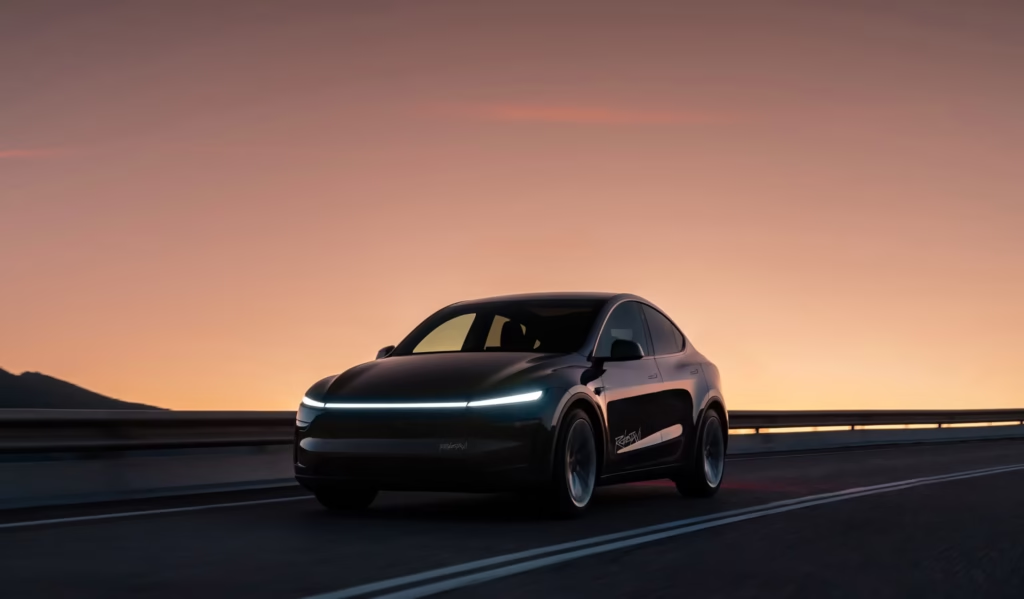
The incidents were disclosed through newly unredacted information submitted to the National Highway Traffic Safety Administration (NHTSA), showing that Tesla’s Robotaxi vehicles in Austin, Texas, have been involved in multiple recorded incidents since the network began operating in mid-2025.
While the crashes reportedly happened at low speeds and caused no injuries, the fact that they occurred under remote human control is likely to raise new questions about Tesla’s autonomous ride-hailing rollout and how much of its safety story depends on human backup systems.
Tesla’s Newly Unredacted Crash Data Reveals Remote-Control Incidents
Tesla, like other companies working on autonomous vehicle systems, is required to submit crash reports to the NHTSA. These reports are part of the agency’s tracking of incidents involving automated driving systems (ADS).
What makes this disclosure notable is that Tesla previously redacted crash narratives, claiming the descriptions were confidential. That has now changed. The updated NHTSA dataset reportedly includes narrative details for all 17 Robotaxi-related crashes Tesla has logged since last year, providing the clearest view yet into the early-stage performance of Tesla’s ride-hailing experiment.
And within those records, two crashes stand out.
Not because they were severe, but because they happened while the car was being controlled by a teleoperator.
Crash 1 (July 2025): Teleoperator Drove Into a Curb and Fence
According to the newly revealed crash description, one incident occurred in July 2025, shortly after Tesla started operating its Robotaxi network in Austin.
The report states that Tesla’s automated driving system struggled to move forward while stopped on a street. At that point, the safety monitor inside the vehicle requested help from Tesla’s remote assistance team.
A teleoperator then reportedly took control of the vehicle, increased speed, and turned it left.
However, the vehicle reportedly drove up onto a curb and hit a metal fence.
This is the kind of incident that may sound minor in isolation, but in the robotaxi world, it is significant. If the system fails, the fallback system must be near-perfect — and this crash suggests that even the human override layer isn’t immune to error.
Crash 2 (January 2026): Teleoperator Hit a Construction Barricade
A similar event reportedly occurred in January 2026.
In this case, Tesla’s automated driving system was driving straight when the safety monitor requested remote support to assist with navigation.
The report says the teleoperator took over control while the vehicle was stopped, then drove forward.
The vehicle reportedly struck a temporary construction barricade at around 9mph, scraping the front-left fender and tire.
Again, no passengers were onboard and no injuries were reported — but the crash raises the same core question: how reliable is Tesla’s remote intervention layer if it can still result in contact with obvious road obstacles?
Tesla Previously Said Teleoperators Can Drive Vehicles Under 10mph
This disclosure ties directly into Tesla’s earlier statements to lawmakers, where the company acknowledged that remote operators can take control of a vehicle under certain conditions, as long as the vehicle remains under 10mph.
Tesla described this feature as a practical tool for moving vehicles out of unsafe or compromised positions without waiting for a field representative or emergency responder.
From a logistics standpoint, it makes sense. Robotaxis cannot always handle complex edge cases, and remote control can prevent gridlock or awkward recovery situations.
But the newly revealed crashes suggest this remote control capability may also introduce new risk factors — including the possibility of teleoperators making mistakes in real time.
That’s not a small detail. It’s potentially a key limitation in Tesla’s robotaxi scalability.
Tesla Robotaxi Crash Reports: Most Incidents Still Involve Other Drivers
To be clear, the report suggests that the majority of Tesla’s recorded Robotaxi incidents involved other vehicles crashing into Tesla’s cars — something also commonly seen with competitors like Waymo.
However, the dataset reportedly includes other notable events, including cases where Tesla Robotaxis clipped mirrors on other vehicles and incidents involving navigation challenges.
One crash from September 2025 reportedly involved a Tesla Robotaxi being unable to avoid hitting a dog that ran into the street. Tesla reported that the dog was able to run away.
Another crash from September 2025 reportedly involved an unprotected left turn into a parking lot, where the vehicle struck a metal chain.
That detail stands out because the industry has already seen automated driving systems struggle with parking-lot barriers, bollards, and chains — and regulators have previously looked into similar scenarios involving Tesla’s driver-assist software.
Why This Matters: Teleoperation Isn’t “Autonomy,” It’s a Safety Crutch
The most important takeaway from this report isn’t that Tesla had minor low-speed incidents. That’s expected in early deployments.
The real issue is perception.
Robotaxis are marketed as a future where vehicles can navigate real cities with minimal human involvement. But teleoperation suggests Tesla still needs a human safety net to handle complex scenarios.
And if the human safety net can also cause crashes, then the entire reliability argument becomes harder to defend.
This is also why Tesla’s rollout pace matters. While competitors like Waymo and Zoox have logged more incidents overall, they also operate at much larger scales. Tesla is still running a relatively limited Robotaxi presence — and yet the incident count is already meaningful enough to attract regulatory scrutiny.
This could become a key reason Tesla is expanding cautiously.
Tesla’s Slow Robotaxi Expansion May Be Linked to Safety Limits
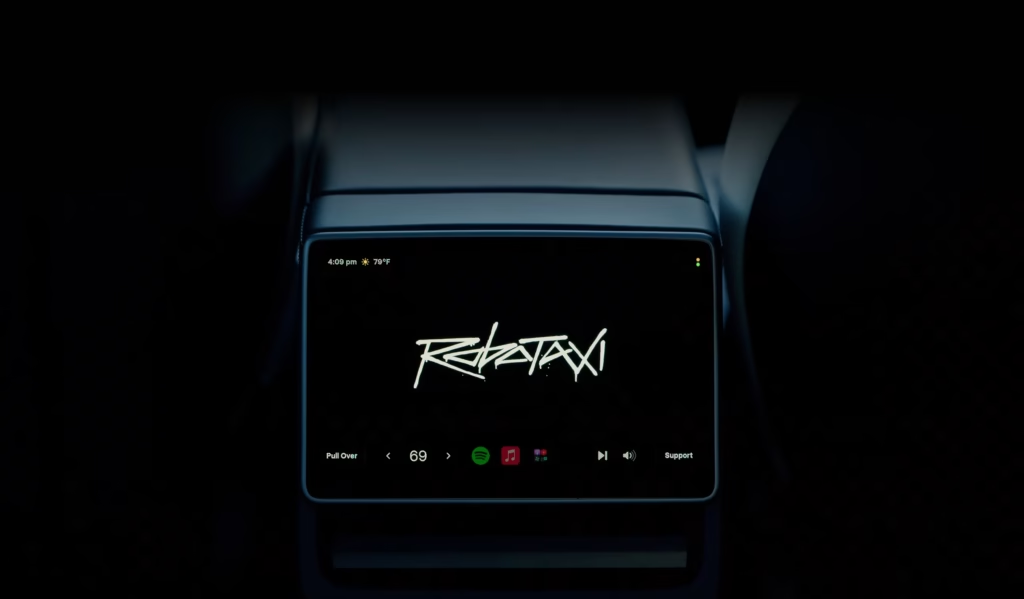
Elon Musk himself recently acknowledged that safety is the biggest factor limiting Robotaxi expansion, saying Tesla is being extremely cautious.
The newly unredacted NHTSA data may help explain that caution.
Scaling a robotaxi network is not just about software updates. It’s about proving consistent reliability, building trust with regulators, and ensuring that every fallback layer — including teleoperators — is dependable.
If Tesla wants Robotaxi to become a mainstream business, incidents like these will likely force the company to refine both its automated driving decision-making and its remote intervention workflows.
This is especially important as Tesla prepares for a future where autonomous vehicles are expected to compete directly with EV ownership itself — a shift that could affect buying decisions for models like the Model Y. Tesla Model Y Variants in India: Which One Actually Makes Sense in 2026?
What This Means for the Robotaxi Race in 2026
The robotaxi industry is reaching a point where small failures become big headlines.
That’s because the promise of autonomy is binary in public perception: either it works, or it doesn’t.
Tesla’s crash data now being visible adds transparency, but it also opens the door for tougher criticism. The industry already knows autonomy is hard — but Tesla’s brand has long relied on the idea that it’s closer than others.
These incidents suggest Tesla’s robotaxi system may still be operating with more human dependency than many consumers realize.
That’s not necessarily a failure, but it is a reality check.
As EV and autonomous technology converge, safety and reliability will likely become the biggest differentiator, especially as battery technology and long-range performance become less unique over time. EV Battery Degradation Explained: 7 Critical Factors That Matter
Final Verdict
Tesla’s confirmation of two Robotaxi crashes involving teleoperators isn’t catastrophic — but it is revealing.
It highlights that even with safety monitors and remote assistance, real-world autonomy remains messy, unpredictable, and heavily dependent on backup systems.
And if those backup systems can also lead to collisions, Tesla’s path to large-scale Robotaxi deployment becomes more complicated.
For Tesla, this is less about damage to a fence or barricade — and more about proving that the system can scale safely, consistently, and with minimal human intervention.
Because in the robotaxi race, confidence matters as much as code.
For the official crash reporting framework and public filings related to automated driving incidents, you can refer to the NHTSA official website.