Microsoft Unveils Surface RTX Spark Dev Box With 1 Petaflop AI Performance for Developers
Quick Highlights
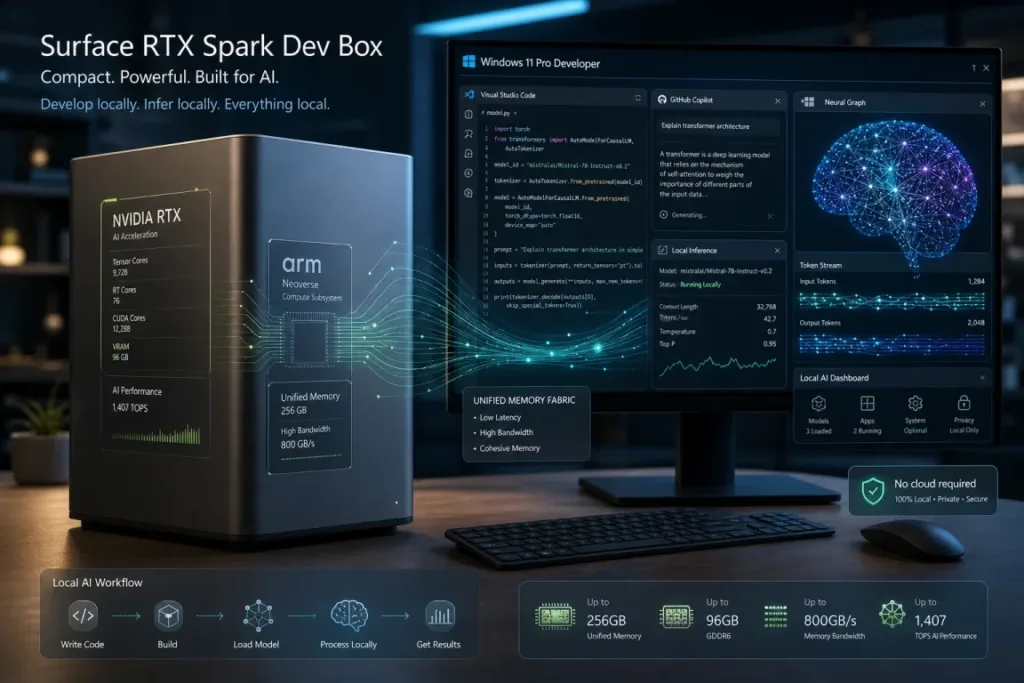
Microsoft has expanded its AI-focused hardware lineup with the introduction of the Surface RTX Spark Dev Box, a compact desktop system designed specifically for developers working on advanced artificial intelligence workloads.
Announced during Microsoft Build 2026, the new device serves as a desktop counterpart to the recently revealed Surface Laptop Ultra and is powered by NVIDIA’s RTX Spark platform. Rather than targeting mainstream consumers, Microsoft is positioning the Dev Box as a dedicated workstation for AI engineers, software developers, and researchers building next-generation AI applications.
Built for Local AI Development
The Surface RTX Spark Dev Box is designed to handle demanding AI workloads that typically require powerful desktop hardware.
Microsoft says the system is capable of running long-duration AI training tasks, agentic AI workflows, local model fine-tuning, and advanced development projects without relying entirely on cloud infrastructure.
As AI development increasingly moves toward hybrid local-and-cloud environments, hardware capable of running sophisticated models on-device is becoming more important for developers and enterprises alike.
This trend is also reflected in Microsoft Launches Scout AI Assistant Inspired by OpenClaw for Microsoft 365 Users, where the company continues expanding its AI ecosystem beyond traditional productivity tools.
Powered by NVIDIA RTX Spark
At the heart of the new developer machine is NVIDIA’s RTX Spark AI superchip.
The platform reportedly delivers up to one petaflop of AI computing performance while integrating NVIDIA’s latest RTX Blackwell GPU architecture. Microsoft says the chip combines AI acceleration, graphics processing, and CPU resources into a single unified platform optimized for AI-first workloads.
The Dev Box can be configured with up to 128GB of unified memory, allowing developers to work with larger AI models directly on local hardware.
The growing importance of dedicated AI hardware was also highlighted recently in NVIDIA’s RTX Spark AI Superchip Will Power a New Generation of Windows PCs, signaling a broader shift toward AI-native computing devices.
Desktop Design Supports Sustained Workloads
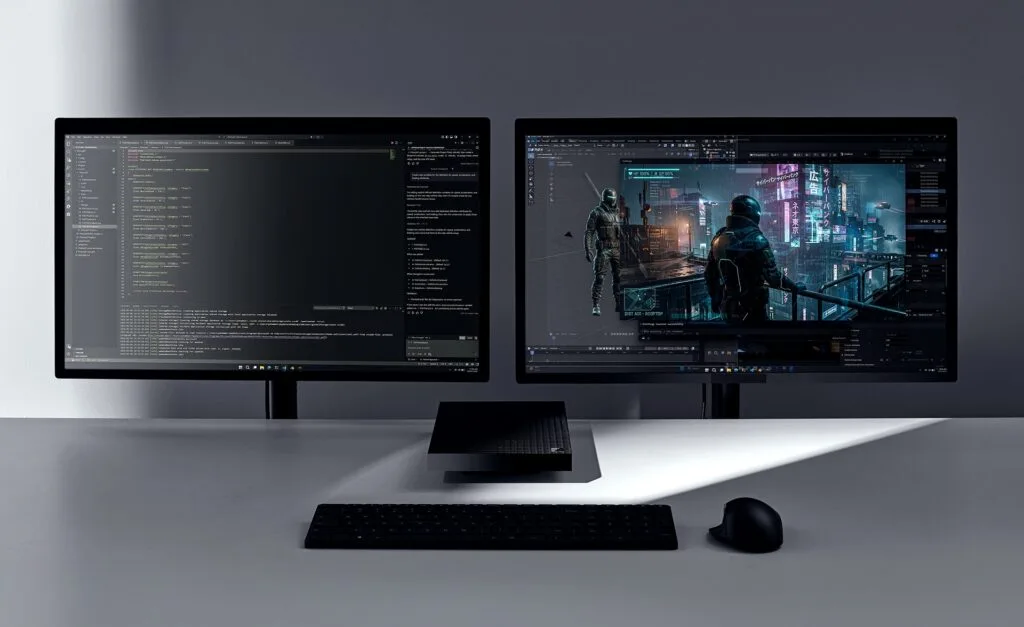
Unlike laptops, the Surface RTX Spark Dev Box is built to sustain heavy workloads for extended periods.
Microsoft says the system operates within a 100W thermal envelope, allowing it to maintain performance during long-running development tasks while benefiting from the power efficiency of Arm-based processing.
This makes the device particularly attractive for developers working on AI agents, machine learning pipelines, and custom enterprise AI deployments that require continuous local processing.
Targeted at Developers, Not Mainstream Consumers
While the RTX Blackwell GPU inside the Dev Box is capable of delivering gaming performance comparable to laptop versions of the RTX 5070, gaming is not the primary focus.
Instead, Microsoft is positioning the hardware as a professional AI development platform similar to systems such as NVIDIA’s DGX Spark and AMD-powered AI developer workstations.
The company has not announced pricing yet, but the device is expected to become available later this year through Microsoft’s official channels rather than traditional retail stores.
For official product announcements and availability updates, users can visit the Microsoft Build Official Website.
TechularZtrix Take
The Surface RTX Spark Dev Box reflects a growing industry shift toward local AI computing. Instead of relying solely on cloud infrastructure, developers increasingly want powerful desktop systems capable of running advanced AI models directly on their machines.
By combining NVIDIA’s RTX Spark architecture with Microsoft’s Surface ecosystem, the company is creating a dedicated AI workstation aimed at the next generation of developers building autonomous agents, generative AI tools, and enterprise AI applications.
While pricing remains unknown, the hardware itself signals Microsoft’s commitment to making AI development a core part of the Windows ecosystem.