Adobe Acrobat Unveils Productivity Agent: Is This the Beginning of the “End of the Static PDF”?
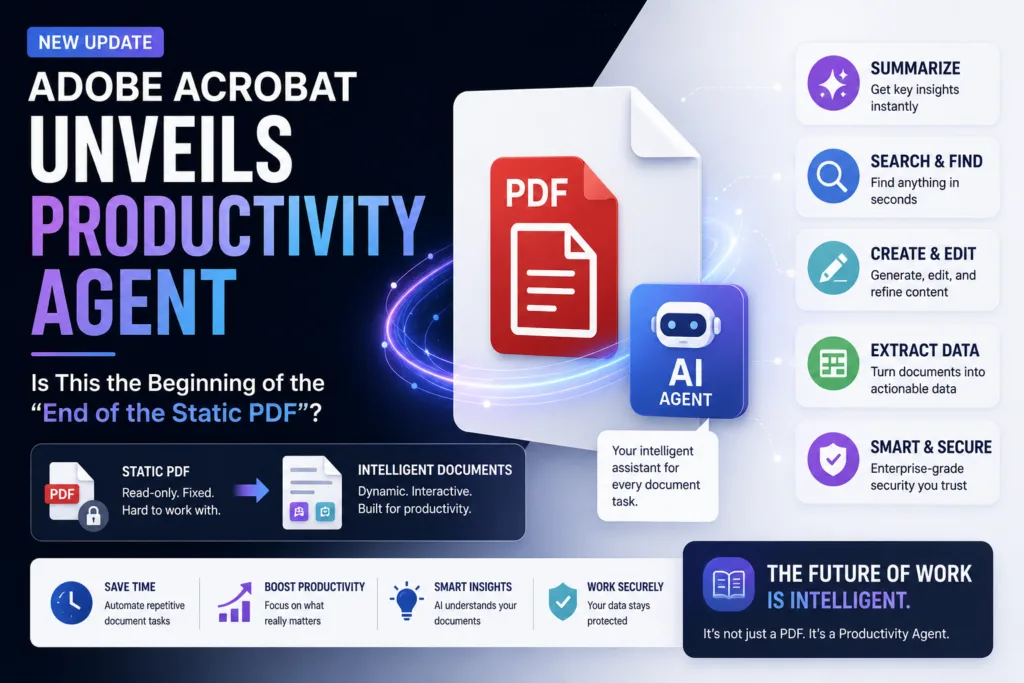
Adobe Acrobat is making a serious move to redefine what a PDF even means in 2026. At Adobe Summit 2026, the company introduced a new feature for Acrobat called the Productivity Agent, and it’s not the usual “AI assistant” upgrade that simply summarizes documents or rewrites paragraphs.
Instead, Adobe is pushing Acrobat into the era of agentic AI—AI that doesn’t just respond, but actively performs tasks, builds outputs, and orchestrates workflows across formats.
If Adobe’s vision works, the PDF may stop being a static file you read and start becoming a dynamic workspace you interact with, share, and repurpose.
Adobe’s Big Shift: From Document Reader to Content Engine
For decades, Acrobat has been the default tool for opening PDFs, signing documents, and exporting forms. But PDFs themselves were built around one limitation: they’re meant to be “final.”
Adobe now wants to flip that model.
The new Productivity Agent is designed to take a PDF and turn it into usable output—something closer to a working asset rather than a locked file. It’s part of a bigger industry shift where software is becoming proactive, similar to what we’re seeing with tools like Beyond Chatbots: Why Perplexity’s “Digital Employee” Is the Real 2026 AI Breakthrough.
This is why the phrase “static PDF” suddenly feels outdated. Acrobat is being rebuilt around action, not just reading.
What the Productivity Agent Actually Does
Adobe’s Productivity Agent is positioned as an autonomous workflow assistant. Instead of stopping at summarization, it aims to create full outputs from your document using natural language prompts.
That could mean turning a report into a presentation outline, extracting key talking points for an audio breakdown, or generating social-ready snippets from a long document.
The bigger point is that Acrobat is no longer behaving like a file viewer. It’s being pushed toward becoming a production layer—similar to how emerging AI systems like OpenAI Operator vs Anthropic Computer Use: Which is Faster for 2026 Coding? are shifting the idea of what “software assistance” actually means.
Why Agentic AI Is the Biggest AI Trend of 2026
The AI era of 2024 and 2025 was defined by chatbots. Ask a question, get an answer.
But 2026 is moving toward a different expectation: users want AI that completes tasks, not just explains them.
Agentic AI is designed to understand an intent and then execute multiple steps to achieve it. Adobe’s Productivity Agent fits perfectly into this trend. Instead of suggesting what to do next, it’s built to generate results.
That’s also why tools like How to Use Google Project Jarvis: 7 Easy Steps Ultimate Setup Guide (2026) are gaining attention—because they reflect the same shift toward AI systems that operate like real assistants rather than search engines.
PDF Spaces: Adobe Wants Document Sharing to Feel Like a Workspace
Alongside the Productivity Agent, Adobe is also upgrading PDF Spaces, which is no longer positioned as just a cloud folder.
Instead, Adobe is describing it as a collaborative environment where PDFs, URLs, notes, and supporting materials can live together in a structured “space.” The AI can then help organize it or tailor it depending on who the content is being shared with.
That matters because the future of productivity isn’t just creating content—it’s packaging it for different audiences. This idea is also central to the growing AI agent movement, especially as discussed in 9 Critical AI Agents in 2026: Why OpenAI Operator and Google Jarvis are Replacing Your Apps.
In other words, Adobe isn’t just improving PDFs. It’s trying to turn PDFs into a system.
Where These Features Will Be Available
Adobe is bundling these capabilities under its premium AI ecosystem, meaning it’s not just a free Acrobat feature drop. The Productivity Agent is tied into Adobe’s broader AI strategy, including Firefly-powered generation and integrations that go beyond traditional document editing.
For creators and professionals, this could be the most important Acrobat evolution in years, because it directly reduces the time spent converting documents into content-ready formats.
Why This Matters: Adobe Is Trying to Kill the “Final Draft” Mindset
The biggest impact here isn’t the feature list. It’s the direction.
PDFs have always represented the “end stage” of work. A final report. A final resume. A final agreement. A final deck.
Adobe’s Productivity Agent changes that philosophy by treating PDFs as living sources of content that can be repurposed again and again, automatically.
If Adobe executes this correctly, Acrobat becomes more than a PDF tool. It becomes a workflow hub for modern creators and business users—where one document can instantly turn into multiple deliverables.
That’s exactly the kind of software shift we’ve seen across AI tools in 2026, and it’s why Adobe’s move feels like a serious industry signal rather than just another AI marketing headline.
TechularZtrix Verdict: Is This the Future of Work?
Adobe’s Acrobat Productivity Agent is one of the clearest signs that productivity software is moving from passive to proactive.
We are heading toward an era where software doesn’t wait for us to click through menus. It understands goals, automates steps, and produces outputs that are ready to publish or share.
If Adobe gets the execution right, Acrobat could become the new center of professional workflow—where the PDF is no longer the end of the process, but the beginning.
And that may be the real story of 2026: the slow death of static files.
For official details, Adobe’s announcement from Adobe Summit 2026 is the best reference point.
It is a new AI feature in Acrobat designed to generate outputs and automate workflows from PDFs, instead of only summarizing documents.
Agentic AI refers to AI that can perform multi-step tasks automatically, acting more like a worker than a chatbot.
PDF Spaces is Adobe’s new collaboration and sharing feature designed to organize PDFs, URLs, and notes into a single AI-assisted workspace.
Adobe is expected to offer it under premium AI plans rather than making it fully free.
Because it signals a shift where PDFs become interactive, AI-powered content sources instead of static files.