Best Open-Source Discord Alternatives in 2026: Stoat vs Element Explained
Quick Highlights

Discord remains one of the most popular communication platforms for gaming communities, fan groups, creators, and online organizations. Its combination of text channels, voice chat, video calls, and screen sharing helped it become the default choice for millions of users worldwide.
However, the platform has also become increasingly controversial. Subscription-focused features, advertising experiments, and new age-verification requirements have led some users to reconsider whether Discord remains the best place to build and manage communities.
For users looking for greater privacy, more control over their data, or the ability to host their own servers, open-source alternatives are becoming increasingly attractive.
Two names in particular continue to stand out in 2026: Stoat and Element.
Why Some Users Are Looking Beyond Discord
Discord’s popularity has never really been in question. The challenge has been maintaining growth while balancing privacy, safety, and monetization.
Recent concerns have largely centered around age-verification systems being introduced to comply with evolving online safety regulations in several regions.
Under proposed verification systems, some users may be required to submit identity documents or biometric verification methods to access certain content or features.
While Discord says these systems are designed to improve safety, critics argue that they introduce new privacy concerns and increase reliance on third-party verification providers.
For many communities, especially smaller private groups, self-hosted platforms are increasingly viewed as a simpler alternative.
What Makes Open-Source Chat Platforms Different?
Unlike traditional social platforms, open-source communication tools allow users to inspect the software’s code, host their own servers, and maintain greater control over how their data is stored and managed.
The biggest advantages include:
- Greater privacy control
- No mandatory subscriptions
- No platform-wide advertising
- Self-hosting flexibility
- Community-driven development
- Reduced dependence on a single company
The trade-off is that users often need to manage their own servers or convince their communities to migrate away from familiar platforms.
Stoat: The Closest Alternative to Discord
Among all open-source chat platforms currently available, Stoat arguably provides the most familiar transition for Discord users.
Formerly known as Revolt, Stoat delivers a user interface that feels immediately recognizable. Channels, servers, permissions, direct messages, and moderation tools all function in ways that closely resemble Discord.
The platform supports:
- Text chat
- Voice calls
- Video calls
- Screen sharing
- Custom emojis
- Server roles and permissions
- Themes and customization
One of Stoat’s biggest strengths is accessibility. Users can choose between self-hosting their own servers or using hosted options provided by the platform.
Because of its Discord-like design, the learning curve is minimal for most users.
If your primary goal is replacing Discord while keeping the overall experience largely unchanged, Stoat is currently one of the strongest options available.
Element: Built Around Privacy and Matrix
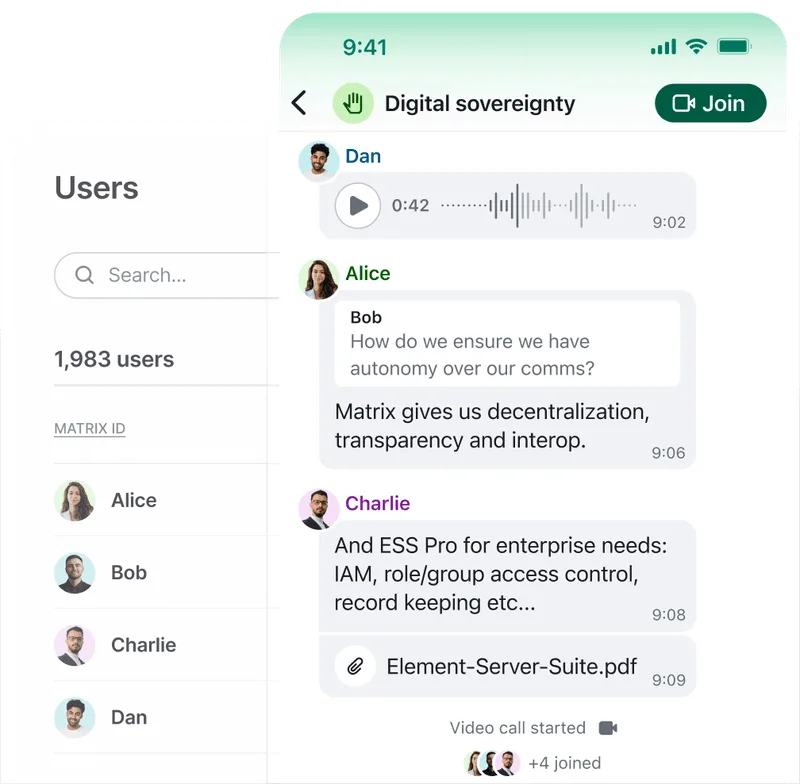
Element takes a very different approach.
Instead of recreating Discord’s experience, Element is built around the Matrix protocol, an open standard designed for decentralized communication.
Matrix allows different servers and applications to communicate with one another while remaining independent.
This means users are not locked into a single provider or ecosystem.
Element supports:
- End-to-end encryption
- Text messaging
- Voice calls
- Video conferencing
- Screen sharing
- File sharing
- Location sharing
- Self-hosting
Because it is based on Matrix, Element also benefits from interoperability with other Matrix-compatible services.
For privacy-focused users, organizations, and businesses, this is a major advantage.
The downside is that Element feels more like a professional collaboration platform than a social community platform.
Users migrating directly from Discord may find the interface less playful and slightly more complex.
Matrix Could Be the Real Winner
While Stoat and Element often get compared directly, the larger story may actually be Matrix itself.
Matrix has steadily grown into one of the most important open communication standards available today.
Instead of forcing everyone onto a single platform, Matrix allows different communities to remain connected while hosting their own infrastructure.
That approach resembles how email works. Users on different providers can still communicate without needing accounts on the same service.
As concerns about platform control, privacy, and moderation continue to grow, Matrix-based ecosystems could become increasingly important over the next few years.
The Biggest Challenge Isn’t Technology
Neither Stoat nor Element faces a major technical limitation.
The real challenge is convincing people to leave Discord.
Most communities stay on Discord because their friends, moderators, creators, and members are already there.
Even when alternative platforms offer better privacy, fewer restrictions, or more control, network effects remain difficult to overcome.
A communication platform is only useful if the people you want to talk to are willing to join it.
That remains Discord’s strongest advantage.
Which One Should You Choose?
For users who want something that feels almost identical to Discord, Stoat is currently the easier recommendation.
For users who prioritize privacy, decentralization, and long-term flexibility, Element is likely the stronger choice.
Neither platform is perfect, but both demonstrate that community communication doesn’t have to depend entirely on large centralized services.
Before migrating an entire community, it’s worth reviewing the official documentation available on the Stoat and Element websites to understand hosting requirements, feature support, and platform limitations.
⚡ TechularZtrix Scan
📌 Bottom Line: Stoat and Element are currently two of the strongest open-source alternatives to Discord. Stoat offers familiarity, while Element offers privacy and decentralization.
⏱ Difficulty Level: Easy to Moderate
⌛ Time Required: 10–30 minutes for setup, depending on whether you self-host a server.
✅ Best For: Gamers, private communities, creators, developers, privacy-conscious users, and organizations looking for more control over their communication platforms.
💡 Why It Matters: As platforms introduce more verification requirements, subscriptions, and platform-wide policies, open-source alternatives are giving users greater ownership of their communities, data, and online conversations.