
GTA 6 Is Coming to Xbox One Through Cloud Gaming on November 19: What Players Need to Know
Microsoft has confirmed a major change to how players will be able to access Grand Theft Auto VI when it launches on…
DISPATCH WIREEXPLORE
 TECHULARZTRIXTMPrecision Technology Editorial
TECHULARZTRIXTM
Humanoid robots have become a regular fixture at major technology events over the past few years. They can walk, dance, climb stairs, and perform carefully choreographed demonstrations that showcase how quickly robotics hardware is improving.
TechularZtrixEDITORIAL DESK · UPDATED 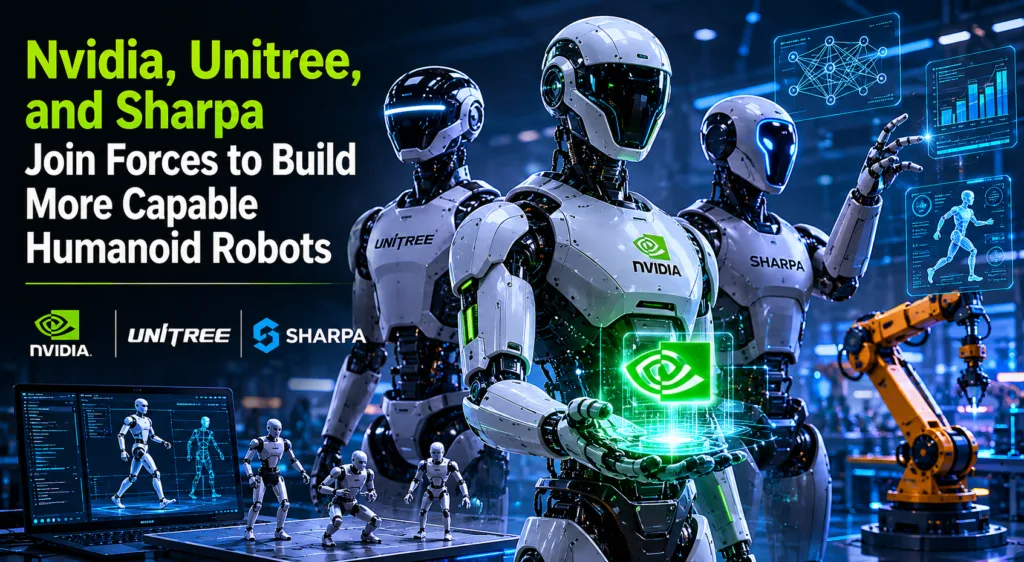
Humanoid robots have become a regular fixture at major technology events over the past few years. They can walk, dance, climb stairs, and perform carefully choreographed demonstrations that showcase how quickly robotics hardware is improving.
The bigger question, however, has always been what happens after the demo ends.
Can these machines reliably perform useful work in factories, warehouses, offices, healthcare facilities, or other real-world environments without constant supervision? That’s the challenge Nvidia, Unitree, and Sharpa are now attempting to address through a newly announced partnership revealed during Computex 2026.
Rather than building a single robot, the companies want to create a blueprint that could help accelerate the development of an entire generation of more capable humanoid machines.
The partnership centers around a reference design known as H2+ or Isaac GR00T.
Think of it as a foundation that robot manufacturers can build upon instead of starting from scratch. The framework is expected to cover everything from AI training and data collection to hardware integration and real-world deployment.
For robotics companies, one of the biggest challenges isn’t necessarily building the robot itself. It’s teaching that robot how to understand and interact with an unpredictable environment.
According to Nvidia CEO Jensen Huang, data remains one of the most difficult obstacles in robotics development. While generative AI has made enormous progress in digital environments, physical AI systems must understand movement, objects, space, and real-world consequences.
That requires a very different level of intelligence.
At the center of the project is Nvidia’s Jetson AGX Thor T5000 platform.
Built on the company’s Blackwell architecture, the chip features 128GB of memory and delivers up to 2,070 FP4 teraflops of AI performance.
The goal isn’t simply raw computing power. Humanoid robots need to process visual information, understand their surroundings, make decisions, and respond in real time while moving through dynamic environments.
Nvidia has been steadily expanding its presence in physical AI, and this partnership reflects a broader strategy that goes beyond traditional GPUs and data centers.
The company’s recent announcements around AI infrastructure and robotics show a growing focus on systems that interact directly with the physical world rather than operating exclusively through software.
One of the most interesting parts of the collaboration comes from Sharpa.
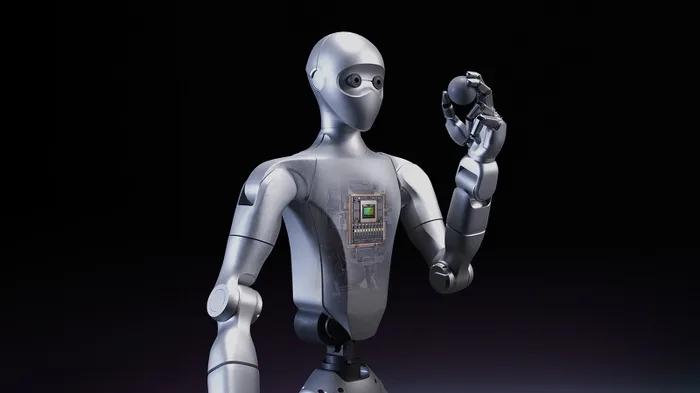
The company is contributing its Wave robotic hands, which feature five fingers designed for more precise manipulation tasks.
Walking across a room is one challenge. Picking up tools, handling fragile objects, sorting products, or performing repetitive industrial tasks is another entirely.
Human hands are extraordinarily complex, and replicating that dexterity remains one of the biggest engineering hurdles in robotics.
Sharpa says its robotic hands are capable of highly detailed movements, including handling playing cards. While that may sound like a simple demonstration, fine motor control is often what separates an impressive prototype from a machine that can perform meaningful work.
Many humanoid robots today are still largely viewed as technology demonstrations.
That’s beginning to change.
Advances in AI models, computing hardware, sensors, and robotic manipulation are gradually making it possible for machines to handle increasingly complex tasks. We are seeing a similar shift across other AI-driven technologies as well, where the focus is moving from experimentation toward practical deployment and real-world utility.
The H2+ reference design is intended to help robotics companies shorten development cycles and create robots that can be customized for specific industries without rebuilding entire systems from the ground up.
That could make future deployments faster, more affordable, and easier to scale.
The announcement also highlights how quickly the robotics industry is evolving.
For years, discussions around artificial intelligence focused primarily on software. Now, many of the world’s largest technology companies are investing heavily in what Nvidia refers to as physical AI—systems capable of understanding and interacting with the real world.
The company also introduced new AI initiatives at Computex 2026, including Cosmos 3, a world foundation model designed to help AI systems better understand physical environments from multiple perspectives.
Taken together, these projects suggest the next phase of AI development may be less about generating text and images and more about enabling machines to operate safely and effectively in the real world.
For more information about Nvidia’s robotics initiatives and AI platforms, users can visit the official Nvidia website.
The most important part of this announcement isn’t the robot itself. It’s the attempt to create a common foundation that other robotics companies can build upon.
The smartphone industry accelerated when manufacturers stopped developing every component independently and began relying on shared platforms. The PC industry followed a similar path decades earlier. Nvidia appears to be betting that robotics could evolve in much the same way.
Whether humanoid robots become commonplace in workplaces over the next decade will depend on far more than processing power alone. Reliability, safety, cost, and real-world adaptability remain major hurdles. But partnerships like this show that the industry is increasingly focused on solving practical deployment challenges rather than simply producing eye-catching demonstrations.
That shift may ultimately matter more than any single robot launch.
Microsoft has confirmed a major change to how players will be able to access Grand Theft Auto VI when it launches on…

WhatsApp is making another significant change to its group messaging experience. The company has announced four new features designed to make it…

If you've ever opened a website on your Android phone only to be greeted by a large "Allow Notifications?" popup before reading…